




About OpenCDN
OpenCDN is a shared infrastructure initiative that helps CDNs to reach Brazilian Internet users with low delay and high quality. It does that by lowering the barriers for CDNs to install their own cache servers in shared infrastructures that are participating in regional IX.br IXPs. Internet Service Providers (ISPs) in these locations can establish a bilateral peering agreement with OpenCDN, to have access to the content provided by the participating CDNs and deliver it to the end users. With OpenCDN, a single cache infrastructure is used by the various ISPs participating in the Internet Exchange Point (IXP), helping to rationalize and organize the Internet infrastructure, helping to make it faster, more resilient and less expensive.
 OpenCDN concept illustrated
What is OpenCDN?

OpenCDN is an initiative of the Brazilian Internet Steering Committee (CGI.br) and the Brazilian Network Information Centre (NIC.br) to promote shared cache-hosting infrastructure at Internet Traffic Exchange Points of IX.br in different regions of Brazil.
CGI.br is a multistakeholder committee responsible for establishing strategic guidelines for the development and governance of the Internet in Brazil, including policies for domain name registration, IP address allocation, and the promotion of security, standards, and innovation. NIC.br is a non-profit organization that acts as its executive arm, implementing these directives and operating key Internet infrastructure and services in the country. CGI.br and NIC.br are the same organizations behind IX.br, the Brazilian Internet Exchange system. OpenCDN is an initiative that promotes the regional development of the Internet by fostering decentralization and enabling a more distributed content delivery infrastructure, helping ensure that major Internet content is available locally across different regions of Brazil through an open and transparent approach.
OpenCDN is already operating in Belo Horizonte, MG, Belém, PA, Brasília, DF, Manaus, AM, Recife, PE and Salvador, BA (main locations), with satellite operations in Caruaru, PE, Feira de Santana, BA and Goiânia, GO. Campo Grande, MS is also expected to join in the near future. If you are a CDN and want to participate, please contact us!
OpenCDN plans to operate in all locations where there are IX.br's Internet Exchange Points, and CDNs are not present by themselves. Implementation will be progressive and will depend on the success of the initiative.
OpenCDN for CDNs

For CDN providers, OpenCDN enables an enter deep strategy in a hard-to-cover market: caches can be placed closer to underserved regions where standalone deployment may not be economically justified, while still reaching multiple local ISPs through the local IX.br IXP.
CDNs are already present in the largest Internet Exchange Points (IXPs) in Brazil, such as IX.br São Paulo, IX.br Rio de Janeiro and IX.br Fortaleza, and within the networks of the largest Internet access providers (ISPs). Doing that, they generally provide a good service for a large number of Brazilian Internet users, but not for all.
Brazil has two big challenges for CDNs:
- a very large number of ISPs, and
- a huge territorial extension.
Brazil has around 9,000 Internet Autonomous Systems, according to Registro.br data. Anatel, the Brazilian Telecom regulator, says that approximately 20,000 companies are licensed to operate telecommunications networks that are normally used in the provision of Internet access (companies with SCM license or registered, but exempt from licensing). There are, therefore, several thousand ISPs serving the Brazilian market. It is also important to understand that there is a concentration on companies that used to be concessionaires of telephony services, but that the majority of the market is distributed among thousands of other ISPs. It is estimated that more than 40% of the Internet market belongs to former concessionaires (incumbents) such as Claro, Vivo and Tim. Thousands of other providers, however, of different sizes, are responsible for bringing fixed Internet to about 60% of users. To install CDN's caches inside the network of biggest operators can be insufficient to reach the majority of users with desired quality and low delay.
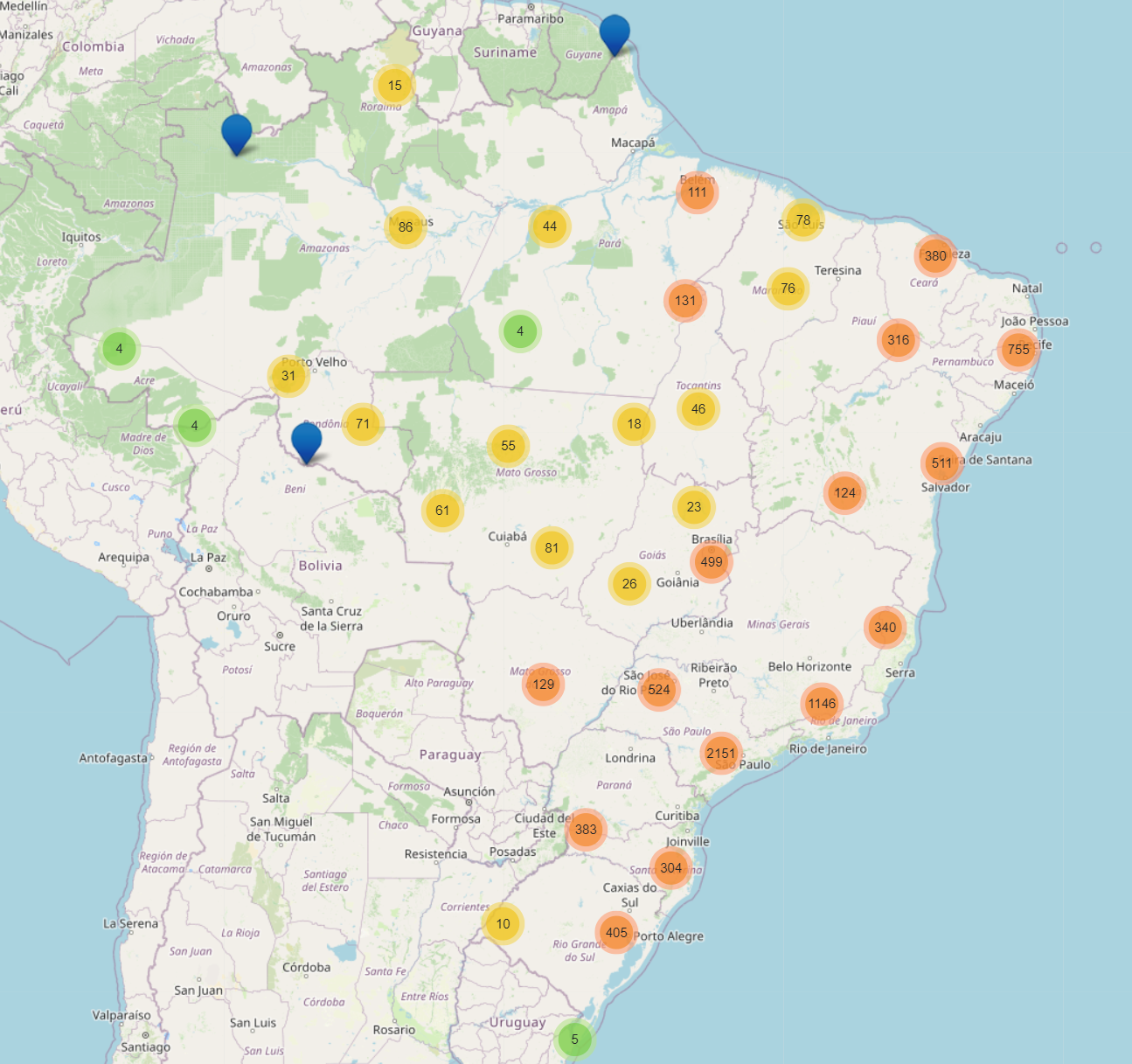 Map of Brazilian Autonomous Systems (https://mapadeas.ceptro.br)
Regarding the geographical extension, Brazil has the area equivalent to 84% of all Europe, and 87% of USA. If we take just the contiguous part of USA, excluding Alaska and Hawaii, Brazil is bigger. The population is more concentrated in the south, south-east, and north-east regions, but it is distributed throughout the territory.Installing CDN's caches only in IX.br São Paulo, or even in São Paulo, Rio de Janeiro and Fortaleza, isn't enough to reach the users with low delay and high quality.
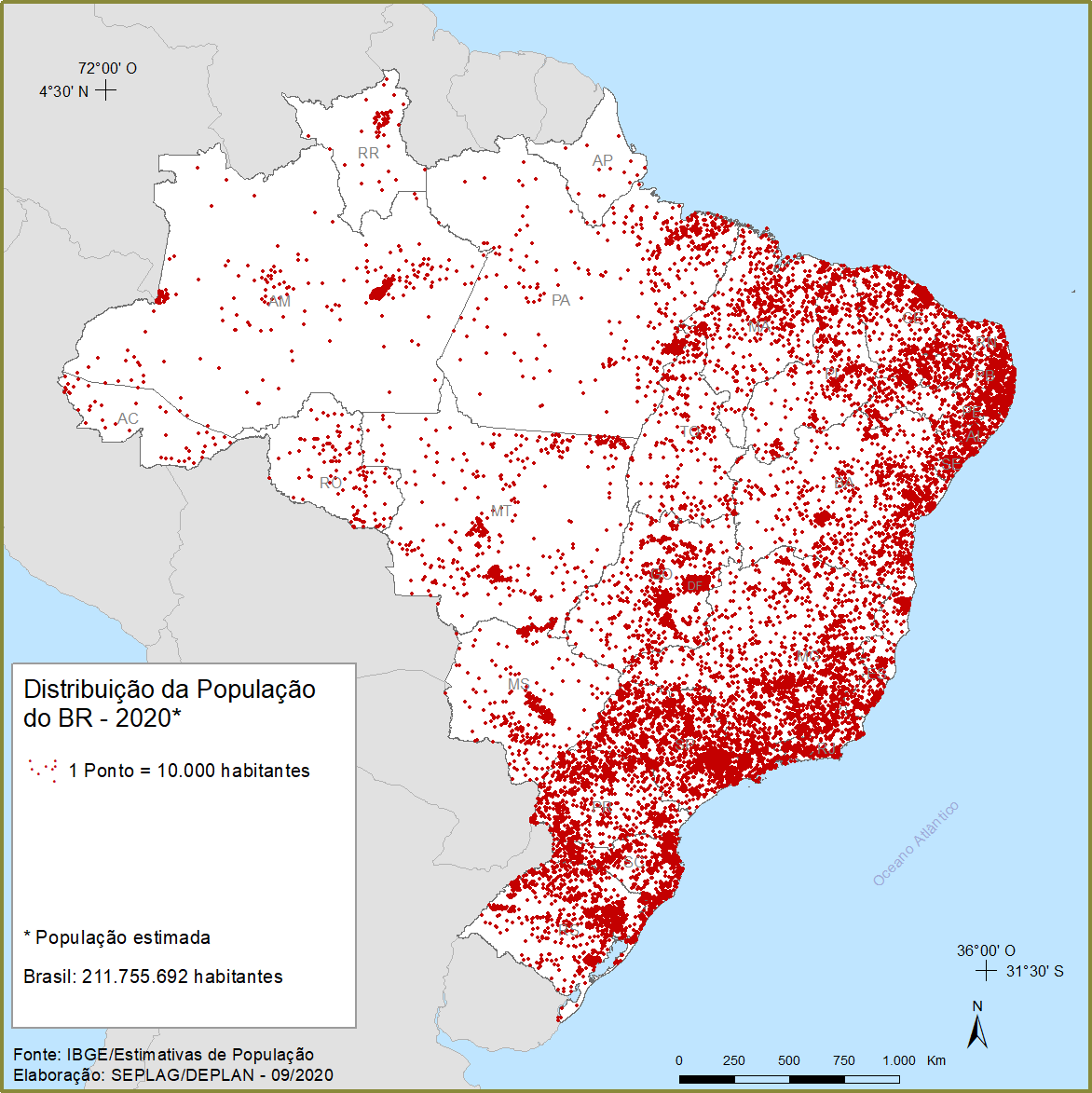 Brazil population distribution (https://atlassocioeconomico.rs.gov.br/distribuicao-e-densidade-demografica)
IX.br's IXPs are present in 39 different locations, currently very well distributed throughout the Brazilian territory. About 30% of Brazilian Autonomous Systems (allocated by Registro.br) that are actively operating (present in the global BGP table) are direct participants in at least one of these locations, having an active session and announcing prefixes on their Route Servers. More than 98% of active Brazilian Autonomous Systems have their prefixes advertised in the BGP tables of the Route Servers of one or more IX.br's IXPs. In this context, distributing CDN caches in the various IXPs of IX.br, either directly or through the OpenCDN initiative, can be an excellent solution for CDNs to deploy their infrastructure in Brazil, achieving with low delay and with a minimum of intermediaries a large percentage of Brazilian AS and, consequently, of Internet users.
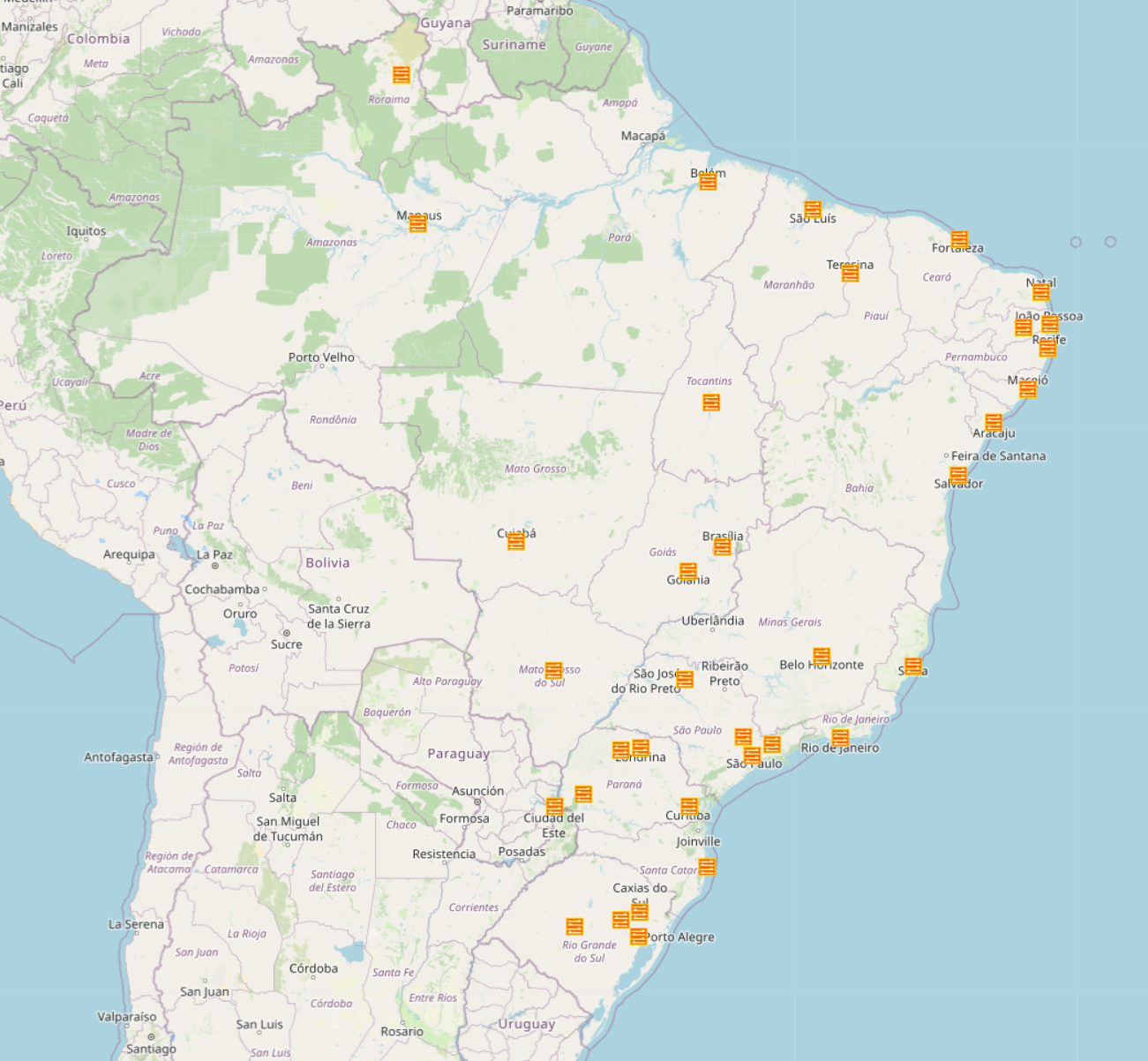 Map of Brazilian Autonomous Systems / IXPs (https://mapadeas.ceptro.br/PTTs)
At each Content Distribution Point (CDP), the following resources are available for CDNs:
- rack space and other resources in the data center suitable for hosting the servers;
-
cache feeding, through the OpenCDN AS (provided as an operational input by NIC.br, who hires IP transit from third parties);
- in most of the geographic locations, an L2 connection is also available to IX.br in São Paulo, where many CDNs have their own infrastructure, through the Autonomous System (AS) of the OpenCDN, so that it is possible to feed caches directly through these infrastructures;
- enough IP address space for the caches, from the OpenCDN Autonomous System, if necessary;
- access through the OpenCDN AS to the local IX.br IXP, in which ISPs and other local ASs participate, so that CDNs can distribute their content locally.
This shared model lowers the per-location investment required for regional expansion, especially in cities where a standalone deployment may not be justified. A single OpenCDN deployment can reach multiple ISPs through the local IX.br IXP, reducing operational friction while keeping caches closer to end users.
OpenCDN is open to all CDNs, both those of the content providers themselves and those that provide this type of service to other organizations.
OpenCDN for ISPs

The content made available by the major CDNs is very important to Internet users. An estimated 70% of a typical ISP's Internet traffic comes from these CDNs. Having access to this content from geographically close caches, with low delay, with the least amount of intermediaries possible, is important to provide speed and quality of access for end users. Furthermore, it is important to consider that the traffic from these CDNs also represents a significant portion of the Internet bandwidth costs contracted by one ISP.
The shared infrastructure of the OpenCDN initiative can benefit ISPs of all sizes. OpenCDN enables ISPs to obtain content from the most important CDNs at the locality's IX.br Internet Traffic Exchange Point, through a bilateral BGP session with AS61580. The OpenCDN AS is the only intermediary, with the possibility for ISPs of establishing their own control policies via BGP communities. The caches are installed locally, which guarantees a low delay. NIC.br is a neutral entity, operating the OpenCDN non-profit and with the experience of those who operate IX.br, which guarantees good costs and quality.
OpenCDN can help ISPs deliver a better quality service to their customers, with better quality perception, higher speed, more resiliency and lower cost.
Shared costs

OpenCDN is non-profit and operated by NIC.br, the same neutral organization that operates IX.br, the world's largest IXP by traffic and ASN count. The operating costs, such as data center fees, L2 interconnection links, and IP connectivity inputs contracted by NIC.br from third parties, are shared. CDNs and ISPs contribute together to make OpenCDN a viable and efficient solution, with no commercial conflict of interest in content distribution. And precisely because the costs are shared, they are low.
OpenCDN is not free of charge for the participant. Although NIC.br also contributes resources to OpenCDN, the majority of expenses are shared between the participant CDNs and ISPs.
CDNs' share in cost-sharing is determined by their energy and datacenter space consumption. That is, the more resources used, the higher the share in the expenses. ISPs' contribution is determined by their infrastructure usage bracket. The more content received from OpenCDN, the higher the share in the expenses.